Introduction: The AI Revolution in Education
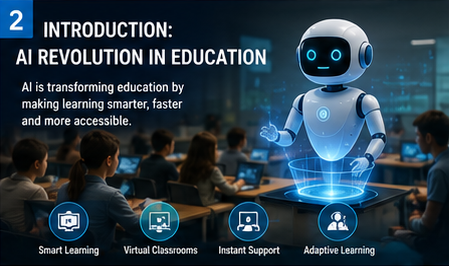
The education sector is experiencing a major transformation driven by artificial intelligence (AI).
From virtual classrooms and adaptive learning platforms to intelligent tutoring systems,
technology is reshaping how students learn and complete assignments. Among the many
AI-powered tools available today, ChatGPT has emerged as one of the most widely discussed
innovations. Developed by OpenAI, ChatGPT is a conversational AI chatbot capable of
answering questions, explaining concepts, generating content, and assisting with
problem-solving across various subjects. The growing popularity of ChatGPT reflects a broader
trend toward digital learning and educational technology. Students increasingly rely on AI tools
to enhance their understanding of complex topics, improve writing skills, and receive instant
academic support. Unlike traditional search engines, ChatGPT provides personalized responses
that can be tailored to individual learning needs, making it a powerful educational resource. As
AI becomes more integrated into everyday learning, educators, parents, and policymakers are
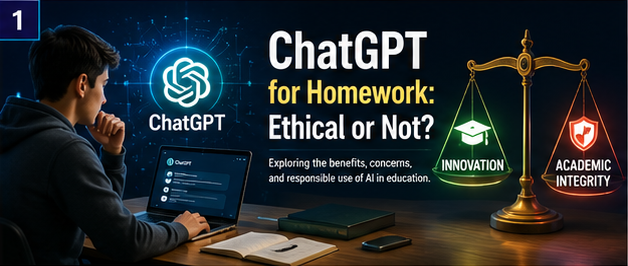
debating its ethical implications. While supporters view ChatGPT as an innovative learning
assistant that promotes accessibility and academic success, critics worry about issues such as
plagiarism, dependency, and academic dishonesty. Understanding both the opportunities and
challenges of AI in education is essential for determining whether ChatGPT should be
considered an ethical tool for homework and learning in the modern classroom.
What Is ChatGPT and Why Are Students Using It?
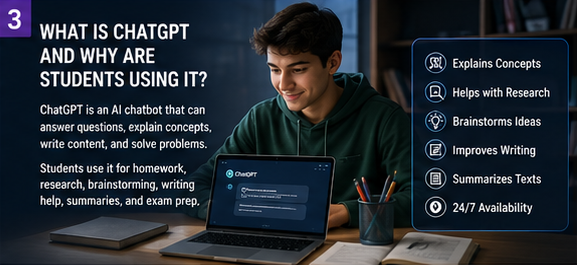
ChatGPT is an advanced artificial intelligence chatbot designed to understand and generate
human-like text. Powered by large language models, it can engage in conversations, answer
questions, summarize information, solve problems, and provide explanations on a wide range of
academic subjects. Its ability to deliver instant and personalized responses has made it one of the
most popular AI learning tools among students worldwide. Students use ChatGPT for homework
in many different ways. It can explain difficult concepts in mathematics, science, history, and
literature, helping learners understand topics that may be challenging in class. Many students
also use it to brainstorm essay ideas, improve grammar, create study guides, summarize lengthy
texts, and prepare for exams. Because ChatGPT is available 24/7, it offers immediate academic
assistance whenever students need support. The popularity of ChatGPT can be attributed to its
accessibility, speed, and convenience. Unlike traditional tutoring services, which may be
expensive or limited by scheduling constraints, ChatGPT provides free or low-cost educational
support on demand. It also adapts explanations to different learning levels, making complex
information easier to understand. As a result, students increasingly view ChatGPT as a valuable
study companion that enhances learning efficiency and supports academic achievement in a
technology-driven educational environment.
The Benefits of Using ChatGPT for Homework
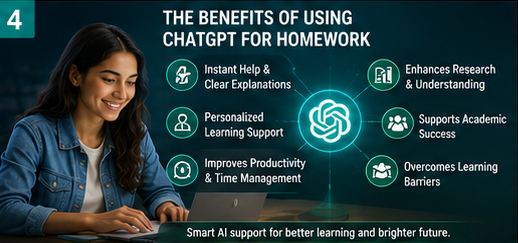
One of the biggest advantages of ChatGPT for homework is its ability to provide instant help and
clear explanations. Students no longer have to spend hours searching through multiple websites
to find answers. Instead, they can receive immediate guidance on difficult topics, making
learning more efficient and less frustrating. This quick access to information helps students stay
engaged and maintain academic momentum. Another major benefit is personalized learning
support. ChatGPT can adapt its explanations to match a student’s level of understanding, offering
simplified descriptions, step-by-step solutions, or more advanced insights when needed. This
individualized approach makes learning more effective and supports students with different
educational backgrounds and learning styles. ChatGPT also improves student productivity and
time management. By assisting with research, note-taking, brainstorming, and content
organization, it helps learners complete assignments more efficiently. Students can focus more on
understanding concepts rather than spending excessive time on repetitive tasks. Additionally,
ChatGPT helps overcome learning barriers. Students who struggle with language difficulties,
limited access to tutoring, or disabilities can benefit from AI-powered educational assistance.
The technology promotes greater accessibility and inclusivity by providing support whenever
and wherever it is needed. When used responsibly, ChatGPT can serve as a powerful educational
tool that enhances learning outcomes, supports academic success, and prepares students for an
increasingly digital future.
The Ethical Concerns Surrounding ChatGPT
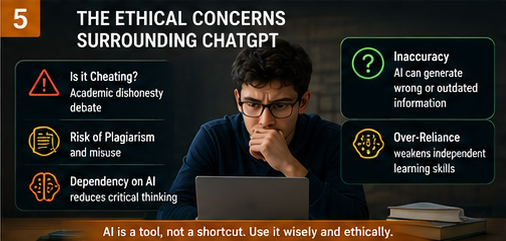
As the use of ChatGPT for homework continues to grow, concerns about its ethical implications
have become a major topic of discussion. One of the most debated questions is whether using
ChatGPT for academic assignments constitutes cheating. The answer often depends on how the
tool is used. If students use ChatGPT to better understand concepts, generate ideas, or receive
explanations, many educators consider it a legitimate learning aid. However, submitting
AI-generated work as one’s own without proper acknowledgment raises serious concerns about
academic integrity. Another significant issue is the risk of plagiarism. Although ChatGPT
generates original responses, students may be tempted to copy and paste content directly into
assignments without making any personal contribution. This practice undermines learning
objectives and may violate school or university policies regarding academic honesty.
Dependency on AI is another growing concern. Critics argue that excessive reliance on artificial
intelligence can reduce critical thinking, problem-solving abilities, and independent learning
skills. When students consistently depend on AI-powered tools for answers, they may miss
opportunities to develop deeper understanding and analytical reasoning. Accuracy is also a
challenge. While ChatGPT is highly advanced, it is not infallible. The chatbot can sometimes
generate incorrect information, outdated facts, or misleading explanations. Students who accept
AI-generated content without verification risk incorporating errors into their work. This
highlights the importance of fact-checking and using reliable academic sources alongside AI
assistance. Ultimately, the ethical debate surrounding ChatGPT centers on responsible use. The
technology itself is neither inherently ethical nor unethical; rather, its impact depends on how
students choose to integrate it into their learning process.
What Educators and Experts Think
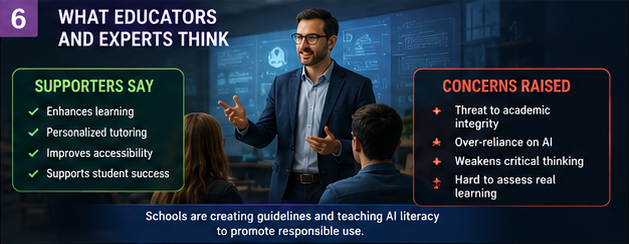
Educators, researchers, and education experts hold diverse opinions regarding the use of
ChatGPT in academic settings. Many supporters view artificial intelligence as a powerful
educational technology that can enhance learning experiences and improve student outcomes.
They argue that AI-powered learning tools provide personalized tutoring, instant feedback, and
accessible educational support, particularly for students who may not have access to traditional
academic resources. From this perspective, ChatGPT can serve as a valuable supplement to
classroom instruction rather than a replacement for teachers. However, concerns from teachers
and schools remain significant. Many educators worry that students may use ChatGPT to
complete assignments without genuinely engaging with the material. This could weaken critical
thinking skills, creativity, and independent problem-solving abilities. Teachers also express
concerns about maintaining academic integrity and accurately assessing student knowledge when
AI-generated content becomes increasingly difficult to distinguish from human-written work. In
response to these challenges, educational institutions are developing new strategies and policies.
Some schools have introduced AI usage guidelines that clarify when and how students may use
tools such as ChatGPT. Others are redesigning assessments to emphasize critical thinking, oral
presentations, collaborative projects, and in-class activities that are less susceptible to AI misuse.
Experts generally agree that banning AI entirely is neither practical nor beneficial. Instead, many
advocate for AI literacy programs that teach students how to use artificial intelligence
responsibly and ethically. By educating learners about the strengths, limitations, and ethical
considerations of AI tools, schools can prepare students for a future where artificial intelligence
plays an increasingly important role in education and the workplace.
When Does Using ChatGPT Become Unethical?
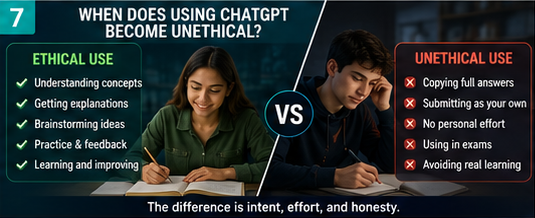
Determining when ChatGPT use becomes unethical requires understanding the difference
between using AI as a learning aid and using it as a substitute for genuine academic effort. Many
educators believe that employing ChatGPT to explain concepts, generate study materials,
brainstorm ideas, or provide feedback on drafts is a responsible and ethical use of artificial
intelligence. In these situations, the student remains actively involved in the learning process and
uses AI to enhance understanding. Problems arise when ChatGPT becomes a homework
replacement rather than a learning assistant. For example, asking the chatbot to write an entire
essay and submitting it without modification or attribution is generally considered unethical.
Similarly, using AI-generated answers during exams or assessments designed to measure
individual knowledge may violate academic integrity policies and constitute cheating. Real-life
examples help illustrate this distinction. A student who uses ChatGPT to understand a complex
mathematics problem and then solves similar questions independently is engaging in ethical
AI-assisted learning. In contrast, a student who copies AI-generated solutions without attempting
to understand the underlying concepts is bypassing the educational purpose of the assignment.
Finding the ethical boundary often comes down to transparency, effort, and intent. Students
should ask whether they are using ChatGPT to learn or simply to complete tasks with minimal
involvement. Responsible AI use requires active participation, critical evaluation of generated
content, and adherence to school guidelines. As artificial intelligence becomes more integrated
into education, establishing clear ethical standards will be essential for balancing innovation with
academic honesty. The goal should not be to avoid AI altogether but to use it in ways that
support genuine learning, skill development, and long-term academic success.
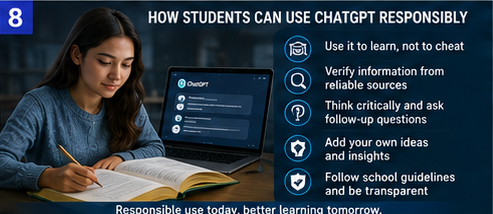
How Students Can Use ChatGPT Responsibly
As artificial intelligence becomes a common part of education, students must learn how to use
ChatGPT responsibly and ethically. While AI-powered learning tools can enhance academic
performance, their value depends on how they are used. Responsible AI use involves treating
ChatGPT as a learning assistant rather than a shortcut to completing assignments. One of the
most important best practices is using ChatGPT to support understanding rather than replace
effort. Students can ask the chatbot to explain difficult concepts, provide study tips, suggest
essay structures, or generate practice questions. However, they should avoid submitting
AI-generated content as their own work without review, revision, or proper acknowledgment.
Maintaining academic integrity remains essential in any educational setting. Verifying
information is another critical responsibility. Although ChatGPT can provide useful explanations
and insights, it is not always accurate. Students should cross-check facts, statistics, and
references using reliable academic sources, textbooks, scholarly articles, and trusted educational
websites. Fact-checking helps prevent misinformation and improves research quality. Equally
important is combining AI assistance with independent thinking. Students should critically
evaluate ChatGPT’s responses, ask follow-up questions, and apply their own reasoning when
solving problems. Rather than accepting answers at face value, learners should use AI-generated
information as a starting point for deeper exploration and analysis. Developing AI literacy is
becoming a valuable skill in the modern world. Understanding both the strengths and limitations
of artificial intelligence allows students to benefit from educational technology while preserving
creativity, critical thinking, and problem-solving abilities. When used responsibly, ChatGPT can
enhance learning, increase productivity, and support academic success without compromising
ethical standards. The goal is not to let AI do the learning but to use AI as a tool that helps
students learn more effectively and independently.
The Future of AI and Homework
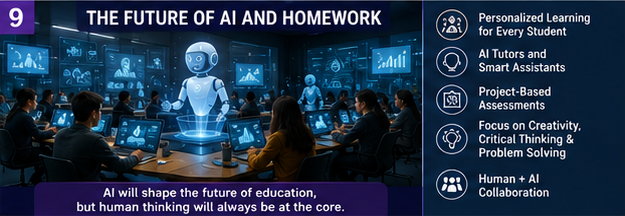
The future of AI in education is likely to transform how students learn, complete homework, and
interact with knowledge. As artificial intelligence technologies continue to advance, tools like
ChatGPT are expected to become increasingly integrated into classrooms, online learning
platforms, and academic support systems. Many experts believe that AI-assisted learning will
become a standard educational resource, much like calculators, search engines, and digital
learning platforms are today. As AI becomes more common, schools and universities may need
to adapt their teaching methods and assessment strategies. Traditional homework assignments
that focus on information recall could become less effective in a world where AI can instantly
generate answers. Instead, educators may place greater emphasis on critical thinking, creativity,
problem-solving, collaboration, and real-world application of knowledge. Assessments may
increasingly involve project-based learning, presentations, discussions, and activities that require
original thought and human judgment. Educational institutions will also need to develop clear
policies regarding AI use. Teaching students about AI literacy, responsible technology use, and
academic integrity will likely become an essential part of modern education. Rather than banning
AI tools, many schools may focus on helping students understand when and how to use them
appropriately. The relationship between students and artificial intelligence is also expected to
evolve. AI may function as a personalized tutor, study coach, writing assistant, and learning
companion that adapts to individual needs and learning styles. This could improve accessibility
and provide support for learners from diverse backgrounds. However, the human element of
education will remain crucial. Teachers will continue to play a vital role in mentoring, inspiring,
and guiding students. The future of education is unlikely to be a choice between humans and AI.
Instead, it will involve collaboration between students, educators, and intelligent technologies to
create more effective, inclusive, and engaging learning experiences.
Final Verdict: Ethical or Not?
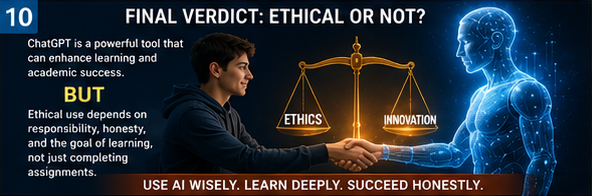
After examining both the advantages and concerns surrounding ChatGPT for homework, it
becomes clear that the technology itself is neither inherently ethical nor unethical. The real
ethical question depends on how students choose to use it. As with many educational
technologies, the impact of ChatGPT on learning outcomes is determined by user behavior,
institutional policies, and the broader educational context. One of the key takeaways from this
discussion is that ChatGPT can be a highly effective learning tool when used responsibly. It
provides instant explanations, personalized learning support, study assistance, and academic
guidance that can help students better understand complex subjects. For learners who lack access
to private tutors or additional educational resources, AI-powered tools can significantly improve
accessibility and learning opportunities. At the same time, concerns about academic integrity
cannot be ignored. Using ChatGPT to generate complete assignments without personal effort,
critical thinking, or proper attribution undermines the educational process. Education is not only
about producing answers but also about developing skills such as problem-solving, creativity,
communication, and independent reasoning. When students rely excessively on artificial
intelligence to complete their work, they risk missing valuable learning experiences. A balanced
perspective recognizes both sides of the debate. Supporters of AI in education emphasize its
potential to enhance learning, while critics highlight risks such as plagiarism, misinformation,
and dependency. Rather than viewing ChatGPT as either a threat or a perfect solution, educators
and students should approach it as a powerful tool that requires responsible use. Encouraging
ethical AI use should be a priority for schools, universities, and students alike. Clear guidelines,
AI literacy programs, and transparent expectations can help learners understand how to benefit
from artificial intelligence without compromising academic honesty. Students should be
encouraged to use ChatGPT for brainstorming, concept clarification, research assistance, and
study support while continuing to engage in independent thinking and verification of
information. Ultimately, the future of education will likely involve collaboration between human
intelligence and artificial intelligence. ChatGPT is not a replacement for teachers, learning, or
critical thinking. Instead, it can serve as a valuable educational companion when used
thoughtfully and ethically. The goal should not be to avoid AI but to learn how to use it
responsibly in ways that promote genuine understanding, academic growth, and lifelong
learning. In that sense, ChatGPT for homework can be ethical but only when it supports learning
rather than replacing it.
Frequently Asked Questions (FAQ)
Using ChatGPT for homework is not automatically considered cheating. The ethicality depends
on how the tool is used and the policies of the educational institution. If students use ChatGPT to
understand concepts, generate ideas, improve writing, or receive study support, many educators
consider it a legitimate learning aid. However, submitting AI-generated work as one’s own
without modification or acknowledgment may violate academic integrity rules and could be
classified as cheating.
Many schools and universities use AI detection tools to identify content that may have been
generated by artificial intelligence. However, these tools are not always accurate and can
sometimes produce false positives or false negatives. Teachers also rely on their knowledge of a
student’s writing style, classroom performance, and assignment quality. The best approach is to
use ChatGPT as a support tool rather than relying on it to produce complete assignments.
Students can use ChatGPT ethically by treating it as a learning assistant rather than a
replacement for their own work. Responsible uses include asking for explanations, requesting
examples, creating study guides, brainstorming ideas, and receiving feedback on drafts. Students
should verify information from reliable sources, think critically about AI-generated responses,
and ensure that their final work reflects their own understanding and effort. Following school
guidelines regarding AI use is also essential.
Artificial intelligence is unlikely to eliminate homework entirely, but it may change how
assignments are designed and evaluated. As AI-powered educational tools become more
common, teachers may shift toward assignments that emphasize creativity, critical thinking,
collaboration, and real-world problem-solving. Homework may evolve from simple information
retrieval tasks to activities that require deeper analysis and personal engagement. Rather than
replacing traditional homework, AI will likely reshape it.
The future of ChatGPT in education appears promising. AI-assisted learning is expected to
become increasingly integrated into classrooms, online learning platforms, and personalized
tutoring systems. Schools will likely focus on teaching AI literacy and responsible technology
use while adapting assessment methods to reflect the growing role of artificial intelligence.
Students who learn to use AI ethically and effectively may gain valuable skills that prepare them
for future academic and professional success.