Research Paper vs Essay: Key Differences Explained
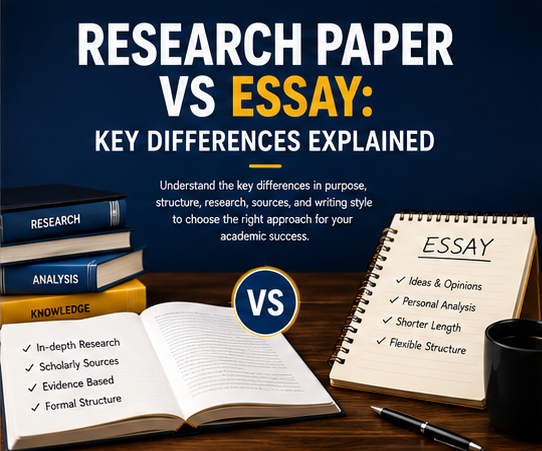
Many students use the terms research paper and essay interchangeably because both are common forms of academic writing. While they may appear similar at first glance, they serve different purposes, follow distinct structures, and require different levels of research and analysis.
Confusion often arises because both assignments involve presenting ideas, developing arguments, and writing in a formal academic style. However, understanding the differences between an essay and a research paper is essential for meeting academic expectations and achieving better grades.
An essay typically focuses on expressing ideas, opinions, or arguments based on the writer’s knowledge and critical thinking, with limited supporting evidence. In contrast, a research paper requires extensive investigation, credible sources, and evidence-based analysis to support a thesis.
In this comprehensive guide, you will learn what an essay is, what a research paper is, their defining characteristics, major similarities, and the key differences between them. We will also compare their structure, purpose, research requirements, writing style, and citation methods.
What Is an Essay?
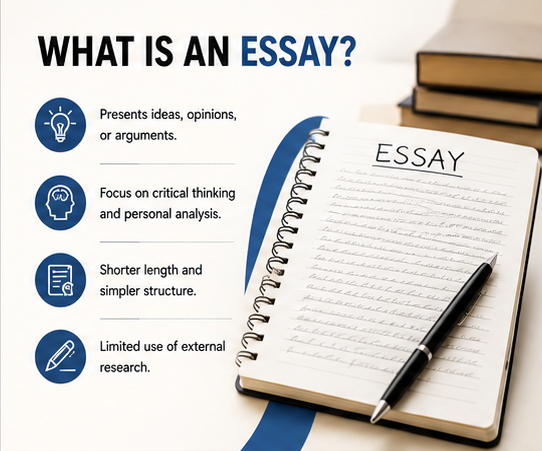
An essay is a short to medium-length piece of academic writing that presents a writer’s ideas, opinions, arguments, or analysis on a specific topic. Its primary purpose is to communicate a clear perspective while supporting it with logical reasoning, examples, and, when appropriate, credible evidence.
Unlike a research paper, an essay generally relies more on critical thinking and personal interpretation than on extensive scholarly research.
Essays are widely used in schools, colleges, and universities to assess a student’s understanding of a subject, analytical abilities, and writing skills. A well-written essay follows a clear structure consisting of an introduction, body paragraphs, and a conclusion. Each section contributes to developing a central thesis statement that guides the discussion.
Common Characteristics of an Essay
A focused topic or central argument
A clear thesis statement
Logical organization with an introduction, body, and conclusion
Coherent paragraphs supported by relevant examples
Formal yet readable academic language
Critical thinking and personal analysis
Limited use of external research compared to research papers
Types of Essays
1. Narrative Essay
A narrative essay tells a story based on personal experiences or fictional events. It emphasizes storytelling techniques, descriptive details, and chronological order to engage readers while conveying a meaningful message.
2. Descriptive Essay
A descriptive essay creates a vivid picture of a person, place, object, or event through detailed sensory language. The goal is to help readers visualize and emotionally connect with the subject.
3. Expository Essay
An expository essay explains a concept, process, or topic using facts, logical reasoning, and objective analysis. It informs rather than persuades and often includes definitions, comparisons, or cause-and-effect relationships.
4. Argumentative Essay
An argumentative essay presents a claim supported by evidence, logical reasoning, and credible examples. It also addresses opposing viewpoints before reinforcing the writer’s position with well-supported arguments.
5. Persuasive Essay
A persuasive essay aims to convince readers to adopt a particular opinion or take a specific action. It combines logical arguments with emotional appeals to influence the audience effectively.
When Are Essays Assigned?
Essays are commonly assigned in high school, college, and university courses across disciplines such as literature, history, sociology, business, psychology, and political science.
Instructors use essays to evaluate a student’s ability to analyze information, communicate ideas clearly, develop logical arguments, and demonstrate subject knowledge. Essays are particularly useful for assignments that emphasize interpretation, reflection, or critical discussion rather than extensive academic research.
What Is a Research Paper?
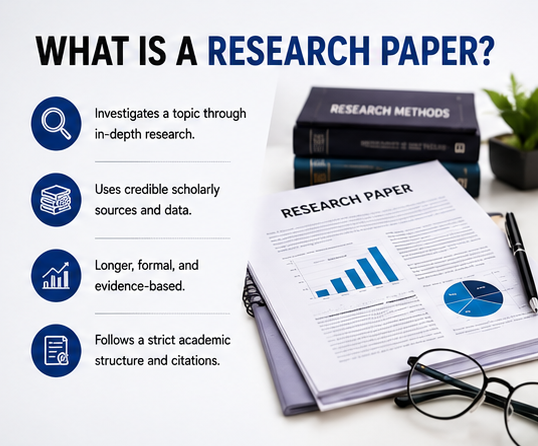
A research paper is a formal academic document that investigates a specific topic through systematic research, critical analysis, and evidence gathered from credible scholarly sources.
Unlike an essay, which often emphasizes personal interpretation, a research paper requires writers to develop original insights by examining existing studies, evaluating evidence, and presenting well-supported conclusions.
The primary purpose of a research paper is to contribute to academic knowledge by answering a research question or supporting a thesis with reliable data and scholarly references. It demonstrates a student’s ability to conduct independent research, analyze information objectively, and communicate findings using accepted academic standards.
A typical research paper includes an introduction, literature review, methodology when applicable, analysis, discussion, conclusion, and properly formatted citations. Depending on the discipline, research papers may follow citation styles such as APA, MLA, Chicago, Harvard, or IEEE.
Key Characteristics of a Research Paper
A clearly defined research question or thesis
Extensive use of credible academic sources
Evidence-based arguments and analysis
Objective and formal academic writing style
Proper in-text citations and references
Logical organization and structured sections
Critical evaluation of existing literature
Original interpretation supported by research findings
Types of Research Papers
1. Analytical Research Paper
An analytical research paper evaluates information from multiple sources and presents an objective analysis rather than simply arguing one viewpoint. The writer interprets evidence, compares perspectives, and develops thoughtful conclusions.
2. Argumentative Research Paper
An argumentative research paper takes a specific position on a controversial issue and supports it with substantial scholarly evidence. It also considers counterarguments before defending the primary claim through logical reasoning.
3. Experimental Research Paper
An experimental research paper reports the findings of original scientific experiments or empirical studies. It typically includes sections such as methodology, data collection, results, analysis, and discussion. This format is common in fields such as biology, chemistry, medicine, psychology, and engineering.
4. Review Paper
A review paper synthesizes and evaluates existing research on a particular topic without conducting new experiments. It identifies trends, research gaps, and future directions while summarizing findings from multiple scholarly publications.
When Are Research Papers Required?
Research papers are typically assigned in undergraduate, postgraduate, and professional academic programs where in-depth investigation is expected. They are common in disciplines such as science, medicine, engineering, economics, education, business, and the social sciences.
Professors assign research papers to assess students’ research skills, critical thinking, ability to evaluate scholarly literature, and competence in presenting evidence-based arguments with accurate citations and academic integrity.
Research Paper vs Essay: Quick Comparison
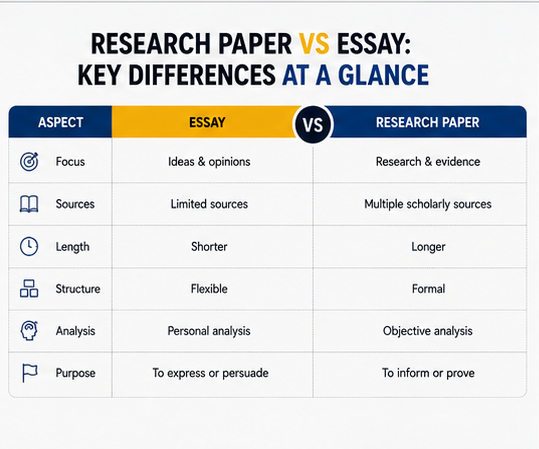
Although both essays and research papers are forms of academic writing, they differ significantly in purpose, research depth, structure, and writing approach.
An essay primarily focuses on presenting the writer’s ideas, opinions, or arguments about a topic. It may include supporting evidence, but it usually relies more on logical reasoning, critical thinking, and personal interpretation.
A research paper, on the other hand, is based on extensive investigation and analysis of credible academic sources. Its goal is to answer a research question, test a hypothesis, or contribute new insights by evaluating existing literature and evidence.
In simple terms: An essay demonstrates your ability to think critically and communicate ideas effectively, while a research paper demonstrates your ability to conduct scholarly research, analyze information objectively, and support conclusions with reliable evidence.
Research Paper vs Essay: 12 Key Differences
1. Purpose and Objective
The primary purpose of an essay is to express an opinion, explain a concept, analyze a topic, or persuade readers using logical arguments. Essays often evaluate a student’s understanding of a subject and ability to communicate ideas clearly.
A research paper aims to investigate a research question through systematic research and evidence-based analysis. Rather than expressing personal opinions, it presents objective findings supported by scholarly sources.
Essay: Focuses on interpretation and argument.
Research paper: Focuses on research, investigation, and academic contribution.
2. Research Requirements
Essays may require only a few reliable references or sometimes none at all, depending on the assignment. Students often rely on classroom materials, textbooks, or personal analysis.
Research papers demand extensive research from academic journals, books, government publications, conference papers, and other credible sources. Writers must evaluate and synthesize multiple perspectives before presenting conclusions.
3. Thesis Statement and Argument
Both essays and research papers include a thesis statement, but its role differs in each format.
In an essay, the thesis expresses the writer’s central idea or argument and guides the discussion throughout the paper.
In a research paper, the thesis is developed after reviewing existing literature and analyzing evidence. It represents a research-backed claim rather than a personal opinion.
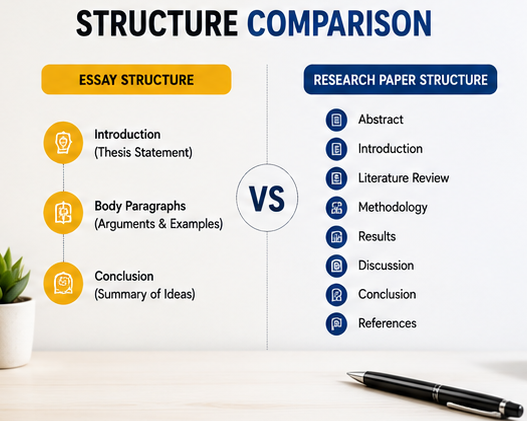
4. Structure and Organization
Essays usually follow a simple structure:
Introduction
Body paragraphs
Conclusion
Research papers follow a more comprehensive structure, which may include:
Title page
Abstract
Introduction
Literature review
Methodology
Results
Discussion
Conclusion
References
Appendices, when required
These additional sections allow researchers to present detailed findings and explain their research process.
5. Evidence and Supporting Sources
An essay often supports arguments with examples, logical reasoning, personal observations, and a limited number of references.
A research paper depends almost entirely on credible evidence gathered from scholarly sources. Every major claim must be supported with reliable data, peer-reviewed studies, statistics, or academic publications. Because of this, research papers generally carry greater academic credibility.
6. Citation and Referencing Styles
Many essays require minimal citations, particularly reflective or narrative essays. However, argumentative and expository essays often use MLA or APA citations.
Research papers require consistent citations throughout the document to acknowledge sources and prevent plagiarism. Depending on the discipline, common citation styles include:
APA
MLA
Chicago
Harvard
IEEE
7. Writing Style and Tone
Essays often allow a slightly flexible writing style, especially narrative or descriptive essays where creativity and personal voice are encouraged.
Research papers use a highly formal, objective, and professional tone. Writers avoid emotional language and unsupported opinions while maintaining clarity and precision. Academic vocabulary and evidence-based language are expected throughout.
8. Length and Depth
Essays are generally shorter assignments ranging from 500 to 2,000 words, depending on the academic level.
Research papers are typically much longer, often ranging from 3,000 to 10,000 words or more. They require in-depth analysis and comprehensive literature reviews. Their greater length reflects the detailed research process involved.
9. Critical Analysis vs Personal Interpretation
Essays encourage students to analyze topics through their own understanding, interpretation, and reasoning.
Research papers prioritize the critical evaluation of existing research. Instead of relying primarily on personal opinions, writers compare studies, identify research gaps, evaluate evidence, and develop informed conclusions.
10. Time Required for Completion
An essay can usually be completed within a few hours or several days, depending on its complexity.
A research paper often takes several weeks because students must:
Select an appropriate topic
Conduct a literature review
Gather credible sources
Analyze information or data
Draft multiple sections
Revise and edit carefully
11. Grading Criteria
Essay grading generally focuses on:
Clarity of ideas
Organization
Grammar
Critical thinking
Argument development
Research paper grading is usually broader and evaluates:
Research quality
Credibility of sources
Methodology
Data analysis
Citation accuracy
Originality
Academic writing style
Overall contribution to the topic
12. Revision and Editing Process
Both assignments require proofreading and revision, but research papers involve a far more detailed editing process.
Essay revisions typically focus on improving clarity, grammar, transitions, and argument flow. Research paper revisions may include:
Verifying citations
Checking factual accuracy
Improving the literature review
Refining the analysis
Formatting references correctly
Eliminating plagiarism
Ensuring consistency across sections
Comparison Table: Research Paper vs Essay
Feature
Essay
Research Paper
Purpose
Express ideas, explain concepts, or persuade readers
Investigate a research question using scholarly evidence
Research depth
Limited to moderate research
Extensive academic research required
Sources
Books, articles, examples, and personal interpretation
Peer-reviewed journals, academic books, research databases, and credible publications
Structure
Introduction, body paragraphs, and conclusion
Title page, abstract, introduction, literature review, methodology, analysis, conclusion, and references
Citations
Minimal or moderate, depending on the essay type
Mandatory throughout the paper using an approved citation style
Length
Usually 500–2,000 words
Generally 3,000–10,000 words or more
Writing style
Formal but may include personal interpretation
Formal, objective, evidence-based, and analytical
Audience
Teachers, professors, or classmates
Professors, researchers, academic institutions, and scholarly readers
Analysis
Personal reasoning supported by examples
Critical analysis supported by scholarly evidence and research findings
Examples
Narrative, argumentative, descriptive, or persuasive essay
Analytical, experimental, review, or argumentative research paper
Overall, essays prioritize communication and critical thinking, while research papers emphasize systematic investigation, academic credibility, and evidence-based conclusions.
Similarities Between a Research Paper and an Essay
Despite their differences, essays and research papers share several important characteristics because both are forms of academic writing.
Clear thesis statement: Both require a central idea that guides the discussion.
Logical organization: Both use an introduction, body paragraphs, and a conclusion.
Evidence-based arguments: Both benefit from credible examples, factual information, and reliable sources.
Strong academic writing: Clarity, coherence, grammar, and precise vocabulary are important in both formats.
Proofreading and editing: Both assignments must be reviewed to improve readability, accuracy, and professionalism.
How to Choose Between a Research Paper and an Essay
Understand the Assignment Requirements
Always read the assignment instructions carefully. If the task asks you to analyze scholarly sources, answer a research question, or present evidence-based findings, you are expected to write a research paper.
If the objective is to express your opinion, explain a concept, or analyze a topic using logical reasoning, an essay is usually the appropriate format.
Consider Your Academic Level
Academic expectations increase as students progress through their education. High school assignments often focus on essays that develop writing and critical-thinking skills. At undergraduate and postgraduate levels, research papers become more common because they require independent research, academic analysis, and proper citation practices.
Follow Instructor Expectations
Different instructors may have specific formatting, citation, and research requirements. Review the grading rubric and ask for clarification if any instructions are unclear. Understanding these expectations before you begin writing can save time and improve the quality of your work.
Evaluate Time and Research Availability
A research paper requires significantly more time than an essay because it involves locating credible sources, reviewing literature, organizing evidence, and citing references accurately. If your assignment requires extensive research, plan your schedule accordingly.
Common Mistakes Students Make
Treating an Essay Like a Research Paper
One common error is adding excessive research and technical sections to an essay. Essays should remain focused on presenting a clear argument or analysis rather than resembling a formal research study with detailed methodology or literature reviews.
Using Insufficient Sources
Research papers require evidence from credible academic sources such as peer-reviewed journals, scholarly books, and reputable databases. Relying on a few websites or unsupported claims weakens the quality of your research and may reduce your grade.
Writing a Weak Thesis Statement
A vague or overly broad thesis can make both essays and research papers difficult to follow. Develop a clear and focused thesis that defines the purpose of your paper and guides every section of your writing.
Improper Citations
Incorrect or missing citations can result in plagiarism, one of the most serious academic offenses. Always follow the required citation style and include accurate in-text citations and reference lists.
Lack of Critical Analysis
Simply summarizing information is not enough. Whether writing an essay or a research paper, analyze evidence, compare viewpoints, evaluate arguments, and explain how your findings support your main thesis.
Tips for Writing a Strong Essay or Research Paper
Plan Before Writing
Begin by understanding the assignment prompt, identifying the purpose of your paper, and defining your main argument or research question. Planning early prevents confusion and creates a clear direction for your writing.
Conduct Credible Research
Use reliable sources such as academic journals, university publications, books, and government websites. Evaluate each source for accuracy, authority, and relevance before incorporating it into your work.
Create a Detailed Outline
Organize your ideas into a logical structure before drafting. An outline helps maintain a smooth flow of information and ensures every paragraph supports your thesis effectively.
Support Every Argument With Evidence
Whether writing an essay or a research paper, support your claims with examples, facts, statistics, or scholarly research. Evidence strengthens your arguments and improves the credibility of your writing.
Edit and Proofread Thoroughly
After completing your first draft, review your work carefully. Correct grammar and spelling errors, improve sentence clarity, verify citations, check formatting, and ensure your arguments are logically connected.
Frequently Asked Questions
Is a research paper harder than an essay?
Generally, yes. A research paper is often more challenging because it requires extensive research, critical analysis, proper citation, and evidence-based writing. Essays usually involve less research and place greater emphasis on presenting ideas and arguments clearly.
Can an essay include research?
Yes. Many essays, particularly argumentative and expository essays, include research to support their arguments. However, the amount of research is typically much less than what is required in a formal research paper.
Does every research paper require citations?
Yes. Citations are a fundamental part of academic research. Every research paper should acknowledge information obtained from external sources using the required citation style, such as APA, MLA, Chicago, Harvard, or IEEE.
Which is longer: an essay or a research paper?
A research paper is generally much longer than an essay. Essays commonly range from 500 to 2,000 words, while research papers often exceed 3,000 words and may be substantially longer depending on the academic level and subject.
Can a research paper be argumentative?
Yes. An argumentative research paper presents a clear position on a topic while supporting that position with scholarly evidence, credible research, and logical analysis. Unlike an argumentative essay, its arguments are built on extensive academic research rather than primarily on personal reasoning.
Conclusion
Understanding the difference between a research paper and an essay is essential for academic success. While both forms of writing require clear organization, strong arguments, and careful editing, they differ significantly in purpose, research depth, structure, citation requirements, and writing style.
Essays primarily evaluate your ability to communicate ideas and analyze topics, whereas research papers assess your skills in conducting scholarly research, interpreting evidence, and presenting objective conclusions.
Before starting any assignment, carefully review your instructor’s guidelines, identify the assignment’s objectives, and choose the writing approach that best fits the requirements. Investing time in planning, conducting credible research, developing a strong thesis, and revising your work will improve the overall quality of your writing.
Whether you are preparing an essay for a classroom assignment or writing a detailed research paper for university, following academic standards and maintaining integrity throughout the writing process will help you produce clear, persuasive, and well-supported work that meets expectations and earns better results.
Study Abroad & Immigration
Planning to Study or Move Abroad?
Along with academic writing support, you can explore expert visa guidance, study abroad opportunities,
and immigration consultation through our trusted platform.